
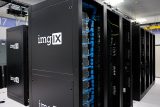
At FOA Glasvezeltechniek, we manufacture a wide range of cables and other products for data centers. Data centers are incredibly important today, and their importance will only continue to grow as we increasingly rely on the internet and digital solutions. People are increasingly using cloud storage, cloud applications, AI solutions, 5G networks, and virtual reality. This applies to many major sectors, including education, healthcare, government, communications, and the commercial sector. Data centers are essential for all these applications. In this blog, we’ll explain what a data center is and what we use it for!
What is a data center?
A data center is an industrial, high-security facility designed to ensure that computer servers running digital applications operate 24/7. Nearly all the services we use on a daily basis depend on a data center. For example, a failure at a data center could prevent you from making payments with your debit card or logging into your bank’s app or website. Professional data centers utilize the latest technology in cooling, infrastructure, power supply, and security. Fortunately, this means malfunctions are extremely rare. The systems in a data center are redundant. This means they are configured with multiple versions, allowing system failures to be mitigated by a backup connection.
Different types of data centers
We can distinguish three different types of data centers:
- Single-tenant enterprise data centers: Enterprise data centers are designed to house the owner’s servers. This is what the term “single-tenant” means. It is a data center dedicated to a single customer. The IT equipment in the data center is used for internal purposes or to provide services to the tenant’s customers.
- Colocation data centers: Colocation data centers are specifically designed to house servers belonging to external customers. These centers lease space to regional, national, and international customers. Customers include cloud providers, hosting providers, and large technology companies, as well as banks, schools, hospitals, and government organizations. In most cases, the servers located in the centers are owned by the customer. The data center’s role is therefore to ensure that all servers continue to operate. Good cooling, connectivity, and power supply are essential for this type of data center.
- Single-tenant hyperscale data centers: Hyperscale data centers are enormous single-tenant data centers, often owned by a major cloud provider or tech company. Examples include companies such as Amazon, Apple, Google, Microsoft, and Meta. Many consumers use the services these companies offer on a daily basis, such as iCloud, Google Cloud, Microsoft 365, and social media platforms like Facebook and Instagram. Employees in a hyperscale data center are, in most cases, more specialized than staff in other types of data centers. This is because these are larger facilities that offer more room for specialization. In addition, it is, of course, very important that these types of data centers continue to operate, given that consumers rely on the services offered by these servers on such a large scale.
Benefits of Data Centers for Businesses
Moving servers to a data center offers many benefits for businesses. We’ve listed the main benefits below:
- Save on costs: A data center is a relatively inexpensive solution for keeping your servers running. You can benefit from high-quality, state-of-the-art equipment and services that would normally cost a fortune. Plus, you don’t need IT staff to keep the servers running.
- Reliable: A professional data center uses redundant systems that are too expensive for most companies to purchase on their own. Redundancy means there is always a backup system ready to take over if a server fails. This ensures that everything keeps running smoothly.
- Scalable: You don’t have to be a huge company to use a data center. You can rent space in a data center on a flexible basis, giving you more options as your business grows. You only pay for the space and energy you actually use.
- Energy-efficient: Data centers in the Netherlands are relatively green. The majority of these centers use green energy and also offer significant energy efficiency benefits. This is partly because the centers utilize the most advanced technology.
- Effective Risk Management: Data centers in our country generally have a robust risk management system in place. Emergencies do occur from time to time, but in most cases, companies are not affected by them. This is because data centers operate on redundant systems, which means there is always a backup of the server