

Are you experiencing a fiber optic outage? Naturally, you’ll want to resolve this as quickly as possible, but to do so, it’s often important to identify the cause of the outage. A fiber optic outage can cause significant disruption, so you naturally don’t want to delay finding a solution. For a business in particular, a fiber optic outage can be extremely inconvenient, as it can prevent you from working. In this article, we’ll tell you more about the possible causes of an outage in your fiber optic connection!
A broken or damaged cable or fiber
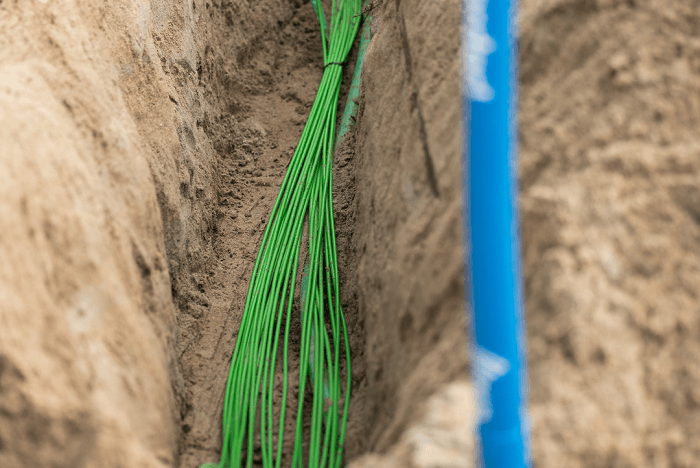
A common cause of a failure in a fiber-optic network is a broken or damaged fiber-optic cable. In such cases, the cable is broken in a way that prevents it from transmitting light, causing the connection to be completely lost. It is also possible that not the entire cable is broken, but only one or more fibers within the cable. This can happen in several ways:
- An excavation incident: It often happens that fiber-optic cables are damaged when they are accidentally struck by an excavator or during other construction work.
- Rodents: Fiber-optic cables aren’t just damaged by excavators—rodents can cause damage too. Since the cables are buried underground, mice or rats are bound to find them at some point. Fortunately, there are ways you can protect your fiber-optic cables from rodents.
Fiber-optic outage caused by dirt or moisture in the cables
Dirt or moisture is also a common cause of fiber optic network outages, but this cause is often overlooked or even underestimated. Yet it is the most common cause of fiber optic outages; in fact, about 70% of outages in a fiber optic network are caused by dirt or moisture. There are several ways in which dirt or moisture can enter the network or get onto a connector:
- Dusty environment: If fiber optic cable is located in a dusty environment, dust particles can settle on the connector. This can significantly affect network performance and even cause a malfunction.
- Exposure to water: If a fiber-optic cable is exposed to water for too long and is not water-resistant, moisture may eventually penetrate the cable. You can prevent this by carefully assessing in advance whether the cables might come into contact with water. If the answer is “yes,” you can opt for special fiber-optic cables designed to be water-resistant.
Micro- and macro-bending
It is also possible that some light gets through, but not in the required amount. This results in lower power. This loss of power is also referred to as “attenuation.” If attenuation becomes too high, it can lead to malfunctions, so it is advisable to take action in a timely manner to prevent such issues. In cases of attenuation, the cable is not broken or damaged. The cause often lies in a bend the cable must make, which may be just too sharp. As a result, light could escape from the fiber at the bend. A distinction is made here between micro- and macro-bends. Macro-bends are bends visible to the naked eye, while micro-bends are bends that can only be seen with a microscope. Micro bends are often the result of a manufacturing defect in the cables, and unfortunately, there is little that can be done about this. This is one of the things we always check our products thoroughly for before they are shipped to the customer, to prevent any malfunctions. Fortunately, there is a solution for macro bends: reducing the bends in the cables or making them less sharp. If that doesn’t work, you can use special fiber-optic cables that have a smaller minimum bend radius.
An error during cable termination
Finally, the cause of a fiber-optic fault may lie in an error during the termination of the fibers. Attenuation can quickly become too high during fusion splicing, which reduces the quality of the cable. All steps in the splicing process must be performed properly and carefully, but of course you cannot verify this yourself if you purchase the cables from a third party. This also applies to the termination of the fiber optic connectors—essentially, the bonding of the fibers. Before bonding and splicing, it is important to test the connection using an OTDR. An OTDR measurement is also an effective way to detect a fiber optic fault. We always check this carefully before shipping our products!